
Adding a Teen Driver in Colorado: A Permit-to-License Auto Insurance Checklist
From learner’s permit to solo driving, learn when to contact your insurer, which coverages to check, and how to compare costs for a Colorado teen driver.
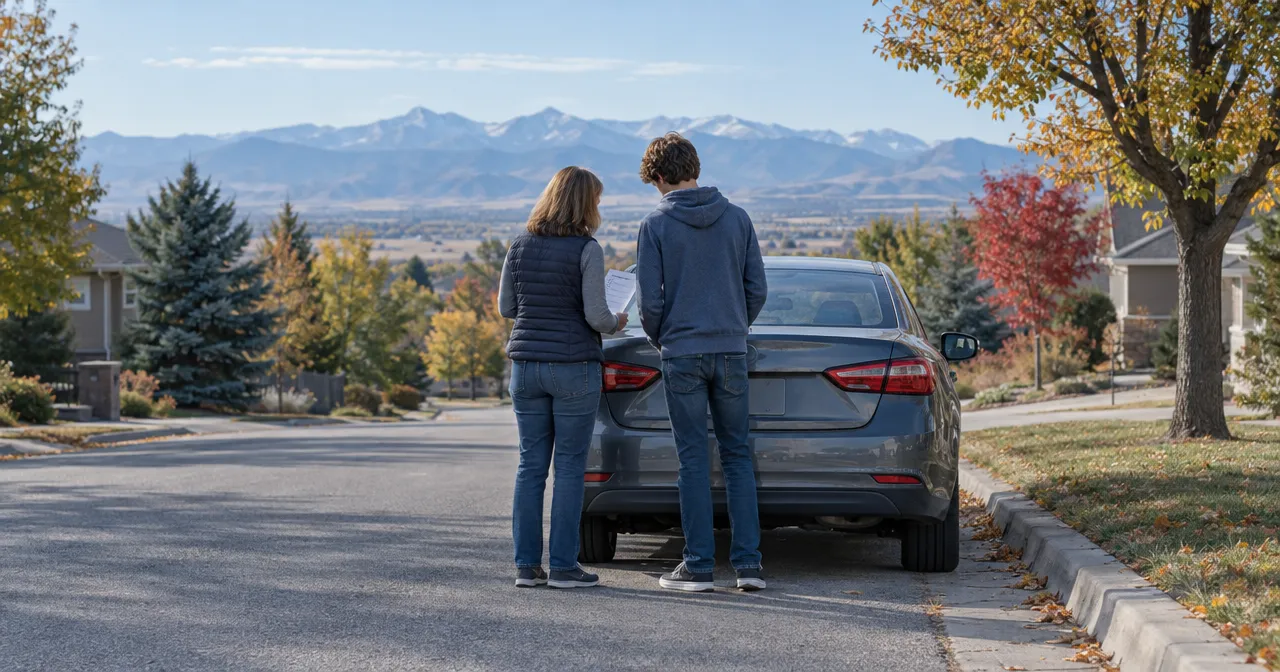
The first supervised drive around a Fort Lupton neighborhood and the first solo trip to school are two different insurance moments. A teen might have access to the family car for months before getting a license, then start using it every weekday. If the insurer still has only the adults and their old driving patterns on file, the family may discover an awkward question after a crash: what did the policy say about this driver and this vehicle?
You do not need to guess whether a learner’s permit automatically changes a premium, or assume that every company handles new drivers the same way. Call your insurer or agent before practice driving begins, and call again before your teen drives alone. Ask how the policy applies at each stage and get the answer reflected in updated policy documents when a change is needed. This checklist combines Colorado’s licensing milestones with the coverage decisions that matter most to a household.
Treat the permit and the license as separate insurance check-ins
Colorado’s graduated driver licensing process moves from supervised permit driving to a minor license with its own restrictions. The Colorado DMV’s under-21 permit and license guide says a learner with a permit must be supervised by an eligible licensed adult. For drivers under 18, the DMV describes a minimum 12-month permit period and a supervised driving log of at least 50 hours, including 10 at night, before a minor license; additional training requirements depend on age. The DMV also describes passenger and nighttime-driving restrictions after licensure. Check the DMV’s current instructions for your teen’s age, rather than assuming a friend’s experience from a different year applies.
At the permit stage: Tell the company your teen has or is about to receive a permit. Give the permit date, the vehicles used for practice, and the names of adults who supervise. Ask whether the teen must be listed as a permitted household driver now, how supervised use is treated, and whether there is any change to premium or coverage. Some companies handle this stage differently from others; a verbal assumption is not a substitute for your own insurer’s answer.
Before the first solo drive: Tell the company the license date, the car the teen will usually drive, and whether the teen will also use other cars in the household. Ask when the driver must be added as a licensed driver and the exact effective date of the change. If a car is purchased or transferred into the household at the same time, verify that the vehicle is also listed before it is driven. Save the revised declarations page and ID cards, and check that names, vehicles, limits, and dates are correct.
There is a near-term licensing change worth keeping separate from insurance: the Colorado DMV says new education requirements take effect January 1, 2027, for people applying for an instruction permit on or after that date. In its September 2, 2026 announcement, the DMV says applicants ages 15–17 will need an approved 30-hour driver education course before a permit, while those who already obtained a permit before January 1, 2027 are not subject to the new education requirement. If your family is planning a 2027 permit, check the DMV’s current rules as well as the insurance timing; they are separate decisions.
Tell the insurer who drives which car
A family may think of a hatchback as “the teen’s car,” but the teen may occasionally borrow the larger SUV for a school trip or drive a parent’s sedan to an appointment. Insurers ask about household drivers and vehicle use for underwriting and rating; a quote based on incomplete information can be misleading. The NAIC’s guidance on insuring a teen driver emphasizes accurate information about the make, model, and year of the car the teen will drive.
When you call, describe the actual pattern rather than trying to find the least expensive way to describe it. For example: “Our 16-year-old will use the 2018 sedan to get to school in Brighton four days a week and may occasionally drive our other vehicle.” Ask whether the company assigns or rates the teen to a particular car, how occasional use of the others works, and what happens if the pattern changes. Also discuss any vehicle that is titled to the teen, kept at a second address, shared between two households, or used for work or delivery. Those details can change the insurance question; do not assume that being related to the policyholder settles it.
Be especially cautious about driver exclusions. If a household member has been specifically excluded, do not treat that person as covered just because they have permission to use the car. Ask for the endorsement and confirm what it says. Likewise, occasional permission for a friend to drive is not the same issue as regularly listing a resident teen; policy language and insurer rules control. The NAIC’s auto insurance guide explains why the declarations page and exclusions deserve a careful read.
Check liability before focusing on the premium
Colorado requires at least $25,000 bodily injury per person, $50,000 bodily injury per accident, and $15,000 property damage liability per accident, according to the Colorado Division of Insurance’s auto insurance guide. Those are legal minimums, not a recommendation for every household. Liability coverage generally responds to injuries or property damage you cause to someone else, subject to the policy’s terms and limits; it does not repair the family car merely because its driver caused the crash.
Consider an illustration, not an estimate of a likely claim: if a covered at-fault crash causes $30,000 in damage to another vehicle and the family has only the $15,000 state-minimum property damage limit, the gap is $15,000 before any other policy or legal considerations. If several people are injured, both the per-person and per-accident bodily injury limits matter. Compare the cost of higher limits with what your family could afford to pay beyond a policy limit. If you also have an umbrella policy, ask what underlying auto liability limits it requires and whether the new driver changes its eligibility or price.
Do not simply copy the limits from a quote comparison that has quietly reduced them. Compare each proposal at the same liability limits and with the same listed drivers and vehicles. For a broader introduction to auto policy components, see our auto insurance page and Denver-area car insurance guide.
Match physical damage coverage to the car and your cash reserve
Collision generally covers damage to your own car from a crash with another vehicle or object or an overturn, subject to the deductible and terms. Comprehensive generally covers other causes such as theft, hail, vandalism, or falling objects. A financed or leased vehicle commonly comes with lender requirements for both. Neither coverage follows automatically from carrying only the liability limits required to drive in Colorado. The Colorado Division of Insurance explains these distinctions in its auto insurance guide.
Picture a family near Firestone that lets its newly licensed teen drive a paid-off, older sedan. If the car is worth about $7,000 and collision carries a $1,000 deductible, the family needs to decide whether paying for collision makes sense against the cost of replacing the car after a covered loss. If the car is financed, lender rules may remove that choice. Now imagine the teen sometimes drives a newer family SUV: verify that vehicle’s collision and comprehensive deductibles as well. The sedan’s lower value does not change the amount the family would owe toward an SUV claim.
A deductible example makes the tradeoff clearer. For a covered $4,000 collision repair with a $1,000 deductible, the insurer’s starting share would be $3,000, subject to the contract and claim adjustment. Choosing a $2,000 deductible instead would increase the family’s starting out-of-pocket share by $1,000. Get actual premium quotes for both choices rather than assuming the higher deductible always saves enough to justify the risk.
Ask about rental reimbursement too: a family car may be unavailable while it is repaired, and rental reimbursement is usually a separate optional coverage with daily and total limits. Check the eligible reasons for a rental and whether a permitted or newly licensed teen can drive the rental under the rental company’s rules; an auto policy benefit does not override a rental company’s driver restrictions.
Review injury coverages, not just damage to cars
A crash can involve medical bills even when the family car has relatively little damage. Colorado’s Division of Insurance says uninsured/underinsured motorist (UM/UIM) bodily injury coverage is included unless rejected in writing. It is designed for covered bodily injury losses involving a hit-and-run, uninsured, or underinsured driver, subject to policy terms. Medical payments coverage generally pays reasonable accident-related health care expenses for insured people and passengers regardless of fault; Colorado policies include $5,000 unless it is rejected in the permitted manner. These are different from liability protection for people your driver injures.
Pull the declarations page and ask: What UM/UIM limits are shown? Was any coverage rejected? What MedPay limit is shown, and how would it work with the family’s health plan? Would the policy treat a teen differently while driving another household vehicle or riding as a passenger? Do not assume a coverage name answers every situation; definitions of insured persons, covered vehicles, exclusions, and policy wording matter.
Compare the full family cost—and discounts that actually apply
Adding a licensed teen often raises the premium, but no single quoted percentage applies to every family. Price depends on the insurer’s rating rules, vehicles, drivers, coverage choices, location, and usage. The Colorado Division of Insurance identifies the addition of a driver and changes in vehicle use among reasons a premium can change. Request a revised quote before the license date so the family can plan, then compare another quote with identical drivers, vehicles, limits, deductibles, and coverage options. A cheap quote that drops collision on a financed car or sharply lowers liability is not a like-for-like comparison.
Ask which discounts you qualify for, and what proof is required. Possibilities to check include good-student, driver-education, multi-car, and auto/home discounts; availability and requirements vary by company. The NAIC’s teen-driver guidance lists these categories but does not promise that any family will qualify. If a carrier offers usage-based or monitored-driving pricing, ask what data it collects, how long it monitors, whether rates can rise as well as fall, and whether every household driver must participate. Compare any quoted savings with the actual terms rather than assuming an advertised maximum will apply.
If the teen later leaves home for school without a car, tell the insurer where the teen lives and whether they still drive on breaks or at school. Do not remove a household driver solely on the assumption that distance means no exposure. Ask when the policy can be updated and what evidence the company needs. A change in vehicle, school address, or regular use can justify another conversation well before renewal.
Bring these questions to your agent
A short, specific call is more useful than asking, “Is my teen covered?” Try this checklist:
- Permit: When must I report the permit, and how does our policy treat supervised driving in each household car?
- License: On what date must the teen be listed as a licensed driver, and when will the revised coverage take effect?
- Vehicles and use: Which car is the teen rated or assigned to, and what if they borrow another car or begin driving to a job?
- Limits: What are our liability and UM/UIM limits, and what would it cost to compare higher liability limits on the same vehicles?
- Damage and expenses: Which cars have collision, comprehensive, rental reimbursement, and roadside coverage, and what are each car’s deductibles or limits?
- Discounts: Which student or driver-education discounts are actually available to us, what documents are needed, and when should we submit them?
- Other policies: Does an umbrella policy, loan agreement, second household, or school-away situation change what we should do?
After the conversation, review the new declarations page rather than relying on a quick text saying the change is “handled.” Check the teen’s information, the vehicle descriptions, effective date, limits, deductibles, and premium. Keep a copy where the adults in the household can find it. If something does not match what you discussed, correct it before the teen’s first solo trip.
A new license changes who drives and how often, but it does not have to turn coverage into guesswork. The Clement Agency helps Colorado families compare auto coverage choices and identify questions worth settling before a claim. If your teen is approaching a permit or license, request a quote or coverage review and share the vehicles and driving plans you expect.